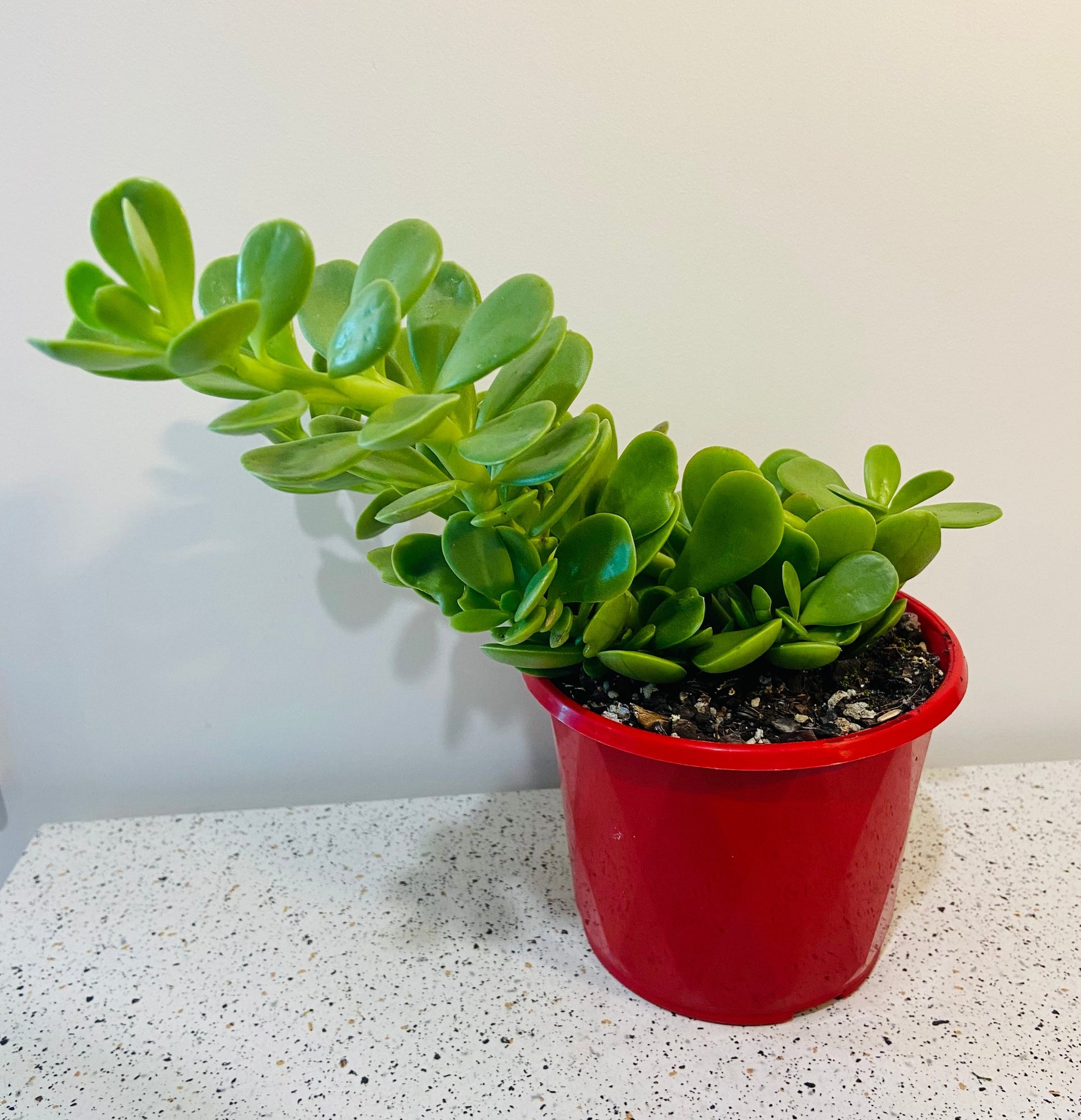
jade trailing plant Buy Senecio jacobsenii Trailing Jade
SKU: 867899375
jade trailing plant

jade trailing plant Buy Senecio jacobsenii Trailing Jade

Sale price$26.01 Regular price$28.90
Save 10%

Pay in installments of $7.22 with ShopPay, AfterPay and Klarna

Shipping Estimate
USA
  • USA
  • CAN

Ships within 48 hours · Estimated delivery Jul 3 - Jul 8

Promo Codes Available:

For Your Every Summer RSVP, with Code: SUMMER15

Description

jade trailing plant Buy Senecio jacobsenii Trailing JadeBuy Senecio Jacobsenii Trailing Jade Online in Australia Senecio Jacobsenii Trailing Jade is a stunning succulent that forms cascading vines of thick, jade green leaves which turn deep purple when exposed to bright light or cooler temperatures. This vigorous trailing succulent is perfectly suited for hanging baskets, elevated planters, and ground cover, creating an elegant display wherever it's placed. Trailing Jade has earned its popularity among

Buy Senecio Jacobsenii Trailing Jade Online in Australia

Senecio Jacobsenii Trailing Jade is a stunning succulent that forms cascading vines of thick, jade-green leaves which turn deep purple when exposed to bright light or cooler temperatures. This vigorous trailing succulent is perfectly suited for hanging baskets, elevated planters, and ground cover, creating an elegant display wherever it's placed. Trailing Jade has earned its popularity among Australian gardeners for its drought-tolerant nature and low-maintenance requirements, thriving both indoors and outdoors across various Australian climates.

This easy-to-grow succulent adapts beautifully to Australian conditions, flourishing in our sunny weather with minimal care. It performs best in partial shade to full sun and requires infrequent watering once established. The thick, fleshy leaves act as natural water reservoirs, allowing the plant to withstand dry periods – perfect for water-wise Australian gardens. Whether grown as a standalone feature or incorporated into succulent arrangements, Senecio Jacobsenii adds vibrant color and graceful trailing form to any garden or indoor collection.

Why Choose Jade?

Cascading Growth Habit: This beautiful succulent features long, slender stems that gracefully trail and cascade up to 60cm, making it an eye-catching centrepiece for hanging baskets or elevated planters throughout Australian homes.

Jade-Like Foliage: The leaves are thick, oval-shaped, and resemble polished jade stones. They display vibrant green tones that transform into stunning purple or magenta hues when exposed to bright Australian sunlight or cooler winter temperatures.

Low-Maintenance Succulent: Jade is remarkably easy to care for, making it an excellent choice for both beginner gardeners and experienced plant enthusiasts across Australia. It thrives in bright, indirect light and well-draining succulent soil.

Drought-Tolerant: Ideal for water-conscious Australian gardeners, this succulent stores water in its thick leaves and requires minimal watering, especially during our hot, dry summers.

Perfect Australian Climate Plant: Adapts well to most Australian climate zones, from subtropical Queensland to temperate southern regions, with frost protection in cooler areas.

Ideal Applications:

Hanging Baskets: Its cascading stems create a stunning display in hanging baskets, adding a touch of greenery and elegance to any room or outdoor space.

Elevated Planters: Placing it in elevated planters or shelves allows its trailing stems to gracefully cascade down, adding a dramatic effect.

Ground Cover: In warmer climates, it can be used as a ground cover in rock gardens or succulent beds, adding texture and color to the landscape.

Care Tips:

Light: Bright, indirect light is ideal. While it can tolerate some shade, ample sunlight will enhance its coloration.

The succulent plant housed in the red pot comes in a 80mm diameter container. While the image provides a representative depiction of what you will receive, but may vary slightly because no two succulents are the same.

Order Your Succulent Today

Add the beautiful Jade to your Australian succulent collection today. Available for fast delivery across Australia from Succulents Online. Perfect for creating stunning hanging displays, ground cover, or adding cascading beauty to your indoor or outdoor plant collection.

Please note — NT, TAS, WA customers: please contact us before placing your order due to additional quarantine charges associated with these locations.                    View Shipping options

Frequently Asked Questions

Shipping Notes
  • Free Standard Shipping on $100+ Orders to the USA.
  • Except Preorder products are shipped in 48 hours.
  • Delivery to the USA:
  1. Standard Shipping : 3-10 business days
  • If time is of the essence, please consider selecting expedited delivery for faster service.
Exchange/Return Notes
  • We offer a 30-day return/exchange service after receiving.
  • Final sale items are not eligible for returns or exchanges.
  • To process your return/exchange, please contact us at [email protected]
  • Please click here for more details>>> Return & Exchange Policy
SKU: 867899375

Discover Niche Categories That Outsell jade trailing plant

Top-Converting Item to Boost Your Average Order

4.7 ★★★★★
Based on 727 reviews
Sort
Highest Rating
Newest First
Oldest First
Product Reviews
J
Verified Purchase
Joseph Somma
Lexington, US
★★★★★ 5
Thorough history
Format: Hardcover
Levy provides a masterful history of American capitalism. His work is detailed and brilliantly written. You should buy this book for its last section: the age of chaos. Here Levy details the US economy since Reagan and identifies critical trends and questions we all need to address. This is not a book for a casual reader, each chapter is hard work. However, the rewards more than outweigh the effort.
WAS THIS REVIEW HELPFUL?YesReportShare
Reviewed in the United States on December 19, 2021
J
Verified Purchase
Joseph
Lowell, US
★★★★★ 5
An interesting look at capitalism in the US
Format: Hardcover
Seller: Product arrived on time in good condition. No issues with the seller at all! Book: This is a pretty dense history of the US through the lense of capitalism. There are quite a few editing errors (typos, incorrect quotation formatting, etc) that are speed bumps to the flow of this book but don’t ruin the reading experience. There are also a few moments where a subjective claim is made using a historical event as a backdrop, but the claim isn’t elaborated on as well as it could be. I chalk this up to the focus of the book being on history and not economics, but I do think if a claim is made it would be interesting to have more data as to why the claim was made.
WAS THIS REVIEW HELPFUL?YesReportShare
Reviewed in the United States on December 5, 2023
G
Verified Purchase
Gary Moreau, Author
Whiting, US
★★★★★ 4
Marx had the proletariat, Mao had the farmers, America has the owners of financial capital
Format: Kindle
What makes Jonathan Levy’s book so informative is that it is truly a parallel history of its politics and its economics. And only by viewing these two intertwined paths side by side can you truly understand the myth of the American free market. America’s politics and its economics have never, since the country’s founding, been separated. The state has been an integral part of everything economic to an extent that would make the most rabid socialist gasp in horror. The only difference is that while the Marxist state stood side by side with the proletariat, and Mao built the number two economy in the world on the support of farmers, America built its economic marvel on the backs of, and for the benefit of, the owners of financial capital. That’s not all bad, mind you. It takes workers, farmers, and the owners of capital to build a modern economy. The tension comes when there is a lack of balance between the importance the state attaches to each. And there can be little surprise that America’s politicians have put the owners of financial capital at the top of their list of priorities. Politicians, after all, can do nothing without power, and power comes via the electoral process, a process that is today fueled by obscene amounts of money. And who has all that money? The American economic narrative is a misleading tale of meritocracy and free markets. The Horatio Alger-based myth is that you are only limited by your skills and your ambition. And like most enduring myths there is a thread of truth to it. Many successful people truly deserve what they have achieved. But does anyone really possess $150 billion of personal merit? Can we statistically accept that the wealthiest nation in the world is also one of the most financially unequal without seeing a pattern of bias? Perhaps the most selectively quoted book in history is Adam Smith’s “Wealth of Nations”, published, strangely enough, in 1776. Often credited with being the father of capitalism, Smith argued that markets free of excessive regulation would be more efficient than markets that were overly regulated, although Smith “made no categorical separation between the political and the economic, or state and market.” Smith did, however, warn against the socially destructive power of monopolies, which unregulated markets will not protect against, and he correctly predicted that the excessive division of labor would lead to a degree of labor and wealth inequity that would destroy society. At the time when US Steel, General Electric, and General Motors, among many others, were the power behind America’s global economic hegemony, most Americans earned a living through wages. And those wages were made possible by long term fixed investments that created jobs. They were generally big bets that took a long time to earn a return but that aligned with the jobs-first priorities of most companies. (Employees first, communities second, shareholders a distant third.) And while not every employee enjoyed the same salary, the differences between the top earners and the average earners was a fraction of what it is today. That era, of course, is long over. The current economy is geared toward the creation of wealth through the short-term investment in assets that will appreciate rapidly and are highly liquid. At the moment that is the stock market and synthetic financial tools pedaled by hedge funds, banks, and the like. The problem is that the wage market encompassed much of America. The asset appreciation market encompasses only a tiny sliver of the richest among us. There is spillover, of course. The lawyers, analysts, consultants, bankers, and sales people who serve the asset appreciation market are doing quite well. But the man or woman who has less education and who might have made a decent living in a steel mill or car assembly plant, has lost out. And despite what the politicians will tell you, the gap is getting wider. (I spent a career in corporate industry, have a college degree in economics, have been a CEO, and have served on four public company boards. I know enough to know that Levy knows what he’s talking about.) The second important point to come out of all this is that economics is not really a “science” as most people think of that term. There is a shared jargon and there are commonly accepted principles. The very idea that there is an economy that is distinct from all other aspects of human existence, including the state, however, is a relatively recent concept. The weakness of the distinction, in fact, is clearly demonstrated by the remarkable reality of just how diverse the history of the American economy is. The sun doesn’t always rise in the east in the world of economics. In each of the economic eras Levy describes it is stunning how few people actually formulated the thinking that defined them. I will join some of the other reviewers in suggesting that the author could have spent more time explaining some of the jargon inevitably found in a treatise on economics. The layman obviously wasn’t his target audience but the book, I believe, could have read more smoothly and been much, much shorter. (The editor and publisher have to take some of the blame for this.) Even if you have to slog your way through the more tedious sections on global capital flows and such, however, you’ll get something from the book even if you’ve never set foot in an economics classroom. If you get no more than the fact that the free market is a myth and that most long term capital that actually creates jobs and income for the average American is actually provided by you, the taxpayer, not the Wall Street capitalist, you will better understand why there is so much division in our country right now. We don’t have a democratic economy. The young wonders of Silicon Valley would have nothing if it wasn’t for your tax dollars and your pension plan, if you’re still lucky enough to have one. We can do better. We have to. The economic inequity we have now is simply not sustainable.
WAS THIS REVIEW HELPFUL?YesReportShare
Reviewed in the United States on August 19, 2022
J
Verified Purchase
Jose Calderon
Battle Creek, US
★★★★★ 5
Good value for the money.
Format: Hardcover
Book in excellent condition, delivered promptly.
WAS THIS REVIEW HELPFUL?YesReportShare
Reviewed in the United States on May 20, 2025
J
Verified Purchase
Jared Dean
Chelsea, US
★★★★★ 5
Great read.
Format: Paperback
Gives a great perspective of how technology has developed and shaped the economy.
WAS THIS REVIEW HELPFUL?YesReportShare
Reviewed in the United States on January 21, 2024

recommand products